Somewhere along the way, personal branding got twisted.
What started as a useful way to communicate your expertise, reputation and value has gradually become something much heavier.
A system or performance. Sometimes, a full-time job on top of the job you already have. You’re told to be visible, valuable, consistent, strategic, memorable and above all…
Be sellable.
So you start posting more.
You refine your bio, rethink your niche, create content pillars, study what is “working”, watch your impressions and begin asking yourself, “What should I share today?” before you’ve even had time to ask, “What do I actually think about this?”
And somewhere in all of that activity, something uncomfortable can happen.
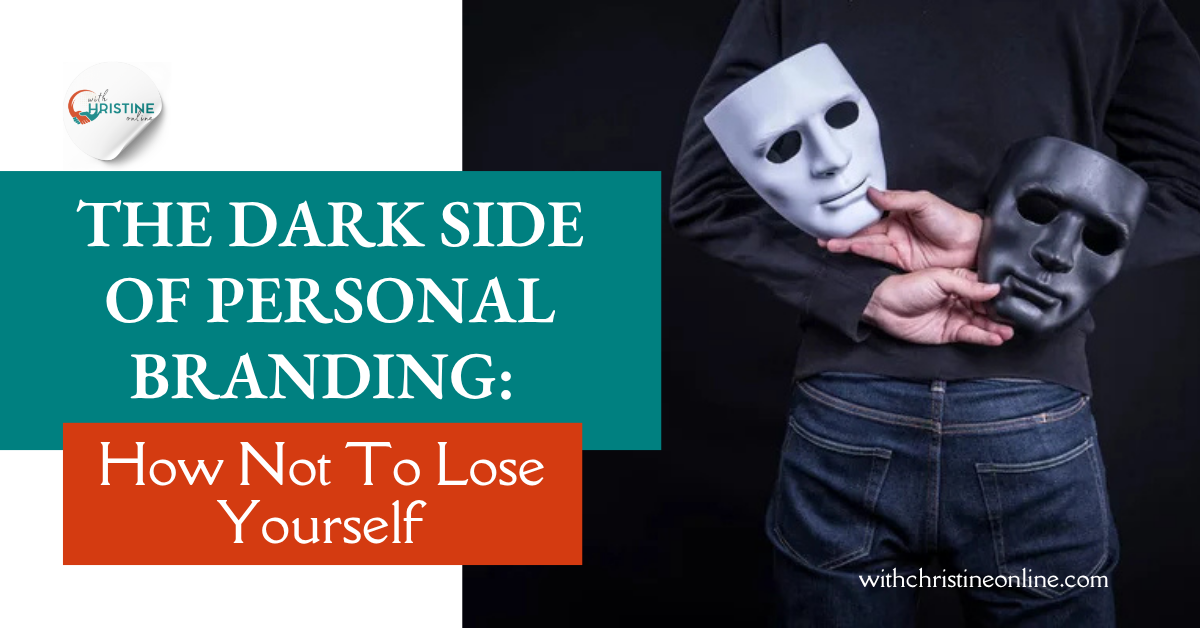
You can become so focused on building your personal brand that you begin losing touch with the person the brand was supposed to represent.
If you’ve ever felt that tension, you’re not imagining it.
Personal branding research itself acknowledges that the field sits at the intersection of self-presentation, identity, reputation and self-marketing and scholars have raised questions about authenticity, sustainability and the boundaries between professional and private identity. (Frontiers)
There is also a genuine paradox here.
We’re constantly told to “be authentic.” But we’re also told to optimize our profile, message, positioning, content and personality for the audience you want to attract.
At some point, you have to wonder:
How authentic can something feel when you’re constantly optimizing it for other people’s reactions?
Sociologist Jennifer Whitmer’s research on self-branding captures part of this tension. Her work examines the contradiction between authenticity and the effort involved in performing a self that is considered worthy of visibility. (Taylor & Francis Online)
And that’s the conversation I think we need to have.
Not because personal branding is inherently bad.
It isn’t.
In fact, a well-built personal brand can help people understand what you do, recognize your expertise and connect you with opportunities that genuinely fit.
The problem is what we’ve started believing personal branding requires us to become.
You were never meant to turn yourself into a product, document every moment of your life, manufacture vulnerability for engagement, chase every trend and become an online version of yourself that is polished enough to impress everyone but exhausting to maintain.
And you certainly shouldn’t have to build a successful brand at the expense of your actual life.
Because if building your personal brand consistently leaves you feeling disconnected, exhausted, performative or trapped, perhaps the answer isn’t to become better at personal branding.
Perhaps it’s to rethink what personal branding is supposed to be in the first place.
So let’s talk about the dark side of personal branding—and, more importantly, how to build a personal brand without losing yourself in the process.

The Dark Side of Personal Branding: What Happens When You Become the Product?
There is a particular kind of exhaustion that comes from constantly thinking about how you are being perceived, especially when your livelihood, career or business increasingly depends on being visible online. You may start with something as innocent as wanting people to understand what you do, but before long, every opinion becomes content, every experience becomes a story and every conversation becomes a potential networking opportunity.
That is where personal branding can quietly cross a line.
The original idea behind personal branding was not necessarily about turning yourself into a polished internet personality, and Tom Peters, who popularized the concept in his 1997 essay The Brand Called You, was essentially arguing that people should recognize and communicate the distinctive value they bring. (Forbes)
But somewhere between that idea and today’s creator economy, the concept became much more commercial. Researchers have even described self-branding as a form of “marketization of self,” where people are encouraged to think of themselves as products that must be continuously developed, presented and marketed. (Compass)
And honestly, you can see why this happens.
When you are a consultant trying to attract clients, a coach trying to establish authority, a freelancer looking for better opportunities or a professional hoping to stand out in a crowded industry, the pressure to package yourself can feel completely rational. You start asking questions like, What is my niche? What should I be known for? What can I sell? What content will attract the right people?
None of those questions is inherently wrong.
The problem begins when every question about yourself becomes a marketing question.
Instead of asking, “What do I genuinely care about?” you start asking, “What will perform?” Instead of “What kind of work do I want to be known for?” you ask, “What positioning will make me more marketable?”
That distinction matters because a personal brand should help people understand your value, not force you to constantly manufacture value for public consumption.
William Arruda, a long-time personal branding expert, makes a similar point when he argues that strong personal brands are grounded in reality rather than fabricated images. He describes authenticity as the foundation of personal branding, not a decorative layer added after the strategy has been created. (Forbes)
And this is where the “you are the product” criticism becomes worth taking seriously.
If you approach personal branding as packaging yourself, you will eventually feel packaged.
You will become overly conscious of your image, your tone, your opinions and even the parts of your personality that seem commercially useful. You may find yourself wondering whether something is worth saying because it reflects your expertise, or simply because it could generate engagement.
But there is another way to think about it.
You are not the product. Your work is.
Your expertise is.
Your ideas are.
Your perspective is.
The transformation you help people create is.
Your personal brand is simply the signal that helps the right people recognize those things.
Think about a lighthouse.
The lighthouse does not manufacture the ships it wants to attract. It simply emits a clear enough signal for the right ships to know where they are and navigate accordingly.
Your personal brand can work in much the same way.
You clarify what you stand for, what you know, how you think and the problems you help solve, then communicate those things consistently enough that the right people begin to recognize you.
That is very different from inventing a personality and hoping people will buy it.
And there is a practical test you can use here.
Before publishing your next piece of content, don’t only ask, “Will this help my brand?” Ask, “Does this accurately represent how I think, work or help people?”
If the answer is yes, you’re probably communicating your brand.
If the answer is no, but you’re publishing it because you think your audience expects it, you’re probably performing one.
That distinction can save you a lot of exhaustion.
Because the goal of personal branding was never supposed to be turning yourself into something people could consume.
It was supposed to make the value you already carry easier for the right people to recognize.
And once you understand that distinction, the next problem becomes much easier to see: the pressure to constantly perform.
Personal Branding Can Create Constant Pressure to Perform
Once your personal brand becomes tied to visibility, the pressure can become relentless. There is always another post to publish, another conversation to join, another trend to understand and another metric quietly asking whether people still care.
For professionals building their reputation online, this can turn visibility into a treadmill. You are no longer simply communicating your expertise; you are constantly monitoring how that expertise is being received.
The pressure is not imaginary. Research on personal branding has identified sustainability as an important concern, while more recent work on digital person-branding describes the tension between the freedom that comes from building a personal brand and the possibility of exploiting yourself in the process. (PubMed Central (PMC))
And social platforms make this harder because they reward consistency and attention. When your opportunities begin to depend on staying visible, taking a break can start to feel less like rest and more like disappearing.
This is where many people make a crucial mistake: they confuse consistency with constant activity.
You do not need to publish every day to have a strong personal brand. You need to communicate a clear point of view consistently enough that people understand what you know, what you care about and what they can expect from you.
There is a difference between being consistently useful and consistently being online. The first builds reputation. The second can simply build exhaustion.
Consider a consultant who posts five times a week because someone told her that the algorithm rewards frequency, even though she has nothing meaningful to say on two of those days. Eventually, she starts recycling opinions she doesn’t fully believe, commenting on conversations she doesn’t care about and creating content simply because the calendar says it is time to post.
That is not a content strategy anymore. It is performance. The better approach is to build your visibility around your actual work.
If you are learning something, share the lesson. If you solve a recurring problem for clients, explain how you approach it. If your experience has changed your perspective, talk about what changed and why.
This is where the popular idea of “document, don’t create” can be useful—not as an excuse to publish everything you do, but as a reminder that your best content often already exists inside your work, experiences and observations.
Research on personal branding supports the importance of self-awareness and reflexivity in the process, rather than treating branding as nothing more than self-promotion.
So before you create another content calendar, ask yourself three practical questions:
What do I already know that could help someone?
What am I currently learning that is worth sharing?
What do I repeatedly help people understand, solve or do better?
Those questions give you something more sustainable than a list of trending topics.
They give you a content system rooted in your actual expertise.
And perhaps most importantly, they give you permission to step away from the internet without feeling as though your entire brand is falling apart.
A strong personal brand should be able to survive your absence.
If disappearing for three days makes you feel as though everything you’ve built will collapse, the problem may not be that you need to post more. Your brand may simply be too dependent on constant performance.
“Be Yourself”—But Only the Acceptable Version
If the pressure to perform is exhausting, the pressure to appear authentic can be even more complicated. After all, personal branding advice rarely tells you to be completely artificial; instead, it tells you to “be authentic,” while simultaneously teaching you how to package that authenticity for an audience.
That creates a strange contradiction: be yourself, but make sure the version of yourself you present is polished, strategic, professional and easy to like.
The tension is not merely theoretical. Sociologist Jennifer Whitmer’s research on self-branding examines precisely this contradiction, showing how the “authentic self” can become something people consciously construct and perform for an audience.
Consequently, you can find yourself editing not just your words, but your personality. You may start wondering which opinions are safe to share, which stories make you relatable and which parts of your life are useful enough to become content.
And because vulnerability performs well online, there can be another subtle pressure: turn your struggles into stories.
Talk about the difficult season.
Share the failure.
Tell people what you learned.
Show the messy middle.
There is nothing inherently wrong with any of that. However, vulnerability becomes problematic when you feel you must expose something personal simply because you believe it will make your brand more relatable.
Recent research published in Computers in Human Behavior found that vulnerability disclosures can influence perceptions of authenticity, but the effects depend on the nature and intensity of what is disclosed. In other words, being more vulnerable is not automatically the same thing as being perceived as more authentic. (DOI)
That distinction is important because authenticity has boundaries.
You can be authentic without telling strangers everything about your marriage, your family, your finances, your private struggles or your personal history. You can also be deeply honest about your professional journey without turning every difficult experience into public content.
In fact, one of the healthiest questions you can ask before sharing something personal is not, “Will this make people connect with me?” but “Am I sharing this because it is genuinely useful, or because I need the audience’s approval?”
Those two motivations can produce very different brands.
The first creates connection with intention. The second can gradually train you to measure your worth by how much of yourself other people respond to.
Therefore, perhaps we need a better definition of authenticity in personal branding.
Authenticity is not showing everything. It is refusing to present something that isn’t true.
You can be strategic and still be authentic. You can choose your words carefully, maintain professional boundaries and decide what remains private without becoming fake.
That is especially important because research suggests authenticity itself can become part of self-presentation; people may strategically present aspects of themselves precisely because those aspects are considered desirable or useful. (sciencedirect.com)
So instead of asking, “How can I look more authentic?”, ask a better question:
“How can I communicate what is true about me without performing a version of myself for approval?”
That might mean sharing the lesson without sharing every detail of the experience. It might mean having a clear point of view without manufacturing controversy, or showing personality without turning your entire private life into a content strategy.
Ultimately, you don’t owe the internet unrestricted access to you in order to have a credible personal brand.
Your brand needs truth, not total exposure.
When Personal Branding Makes Money the Only Measure of Success
The pressure to perform is not the only trap; there is another one that can be even harder to notice because it often looks like progress. You start measuring the value of your personal brand almost entirely by its ability to make money.
Of course, money matters. If your personal brand supports your business or career, it is perfectly reasonable to want it to generate clients, opportunities, partnerships or income.
The problem begins when profit becomes the only filter through which you make decisions about your work.
At first, the shift can seem harmless. You start with something you genuinely enjoy, notice that people respond to it, and then naturally begin thinking about how you can turn that interest into an offer.
That is business, and there is nothing wrong with it.
However, over time, the question can quietly change from “How can I build a sustainable business around what I care about?” to “What should I become because this is what the market is buying?”
That is where things get complicated.
Research on personal branding shows that monetary outcomes are one of the reasons people build personal brands, alongside career advancement, visibility, differentiation, influence and social capital. At the same time, scholars have raised concerns about the commodification of the self and the pressure to treat personal identity as something that must continually produce market value. (PubMed Central (PMC))
And you can see this tension everywhere.
Someone starts talking about a subject because they genuinely care about it. The audience grows, the content performs well, and suddenly the person is encouraged to turn it into a course, coaching programme, newsletter, community, speaking offer or consulting business.
Again, none of those things is inherently bad.
But what happens when the market moves on?
You may discover that the subject you’ve become known for is no longer the subject you want to spend the next five years talking about. Yet because your reputation, income and positioning are now attached to it, changing direction feels like throwing away everything you’ve built.
That is the danger of allowing profitability to become the sole architect of your personal brand.
Your brand starts following the market instead of helping you make intentional decisions about where you want to go.
A healthier approach is to look for the intersection of three things:
What you’re good at.
What you genuinely care about.
What people actually need and are willing to pay for.
The sweet spot is not necessarily the thing that makes the most money today. It is the area where your capability, conviction and market value can continue developing together.
This matters because markets change.
Algorithms change.
Industries change.
Customer preferences change.
What is highly profitable today may be completely ordinary three years from now. A brand built entirely around what is currently selling therefore has to keep reinventing itself to remain commercially relevant.
But when your brand is anchored in deeper things—your expertise, values, perspective and purpose—you have something more durable to build on.
That does not mean ignoring money or romanticizing passion.
In fact, meaningful work still needs a viable business model if you want it to support your life. Recent research on influencers and meaningful work highlights precisely this tension: people may care deeply about their work while still needing to understand and communicate its economic value. (Sage Journals)
The goal, then, is not to choose between meaning and money.
It is to make sure money does not become the only reason you make decisions about your identity, work and direction.
A useful question to ask yourself is:
“If this stopped being profitable tomorrow, would I still want to be associated with it?”
Your answer does not have to be an immediate yes. But if it is a strong no, it may be worth examining whether you are building a personal brand around something you genuinely want—or simply around something the market currently rewards.
Because a personal brand should help you build a valuable career or business without forcing you to become permanently dependent on whatever happens to sell next.
Money can validate a business. It should not have to define a person.
When Your Personal Brand Starts Exploiting You
There is another problem that often appears once your personal brand begins generating opportunities: your work can start following you everywhere. What was supposed to create freedom can gradually become another reason to stay online, keep working and make yourself available long after the actual workday has ended.
You answer messages while eating dinner, think about content while trying to rest, turn ordinary experiences into possible posts and feel guilty whenever you are not doing something to grow your visibility. Eventually, there is no clear line between you and the business built around you.
This concern is not simply anecdotal. Research published in Organization Studies describes how digital person-branding can create a form of emotional labour in which people publicly display aspects of their private lives and transfer commercial expectations into their personal space, creating conditions that can encourage self-exploitation. (CBS Research Portal)
And that is particularly relevant when your name is attached to the business.
A company can close its office at 5 p.m., but what happens when you are the office, the marketing department, the salesperson and the product? Without deliberate boundaries, every break can feel unproductive because there is always another part of the brand you could be working on.
However, the answer is not to separate yourself completely from your brand.
The answer is to build a brand that creates leverage instead of demanding unlimited access to you.
That means asking practical questions before you build your next offer or content strategy: What parts of my work genuinely require me? What can be documented, delegated, automated or turned into a repeatable process? How can my reputation continue creating opportunities without requiring me to personally respond to everything?
These questions matter because personal branding should make your expertise easier to access, not make you permanently accessible.
For example, if you are a consultant, your brand might communicate your approach so clearly that potential clients understand your expertise before they ever book a call. If you are a coach, your content can answer recurring questions before they reach your inbox, while your services provide the deeper transformation that actually requires your involvement.
In other words, your brand should do some of the explaining before you enter the room.
That is leverage.
Similarly, you need boundaries around what belongs to your professional identity and what remains yours alone. Research on professional-personal boundary work shows that people actively negotiate these boundaries and that deliberate segmentation can help protect personal time and wellbeing rather than simply treating constant integration as the ideal. (Sage Journals)
So decide what your audience gets access to.
Decide when you create content.
Decide when you respond to clients.
Decide what parts of your life remain private.
Decide what you are willing to talk about publicly and, just as importantly, what you are not.
These decisions may seem restrictive at first, but they actually give your brand room to grow without consuming your entire life.
Because a personal brand that only works when you are constantly working is not creating freedom; it is creating dependency.
And that brings us to another subtle cost of personal branding: when every relationship starts looking like a potential business opportunity.
When Relationships Start Becoming Transactional
There is another subtle shift that can happen when you start taking personal branding seriously: people can stop looking like people and start looking like opportunities. Instead of meeting someone and becoming curious about their work, ideas or experiences, you find yourself immediately wondering what they can do for your career, business or visibility.
You connect because they have a large audience. You comment because they might notice you. You send a message because you want something. Then, once the opportunity disappears, so does the relationship.
That approach may produce contacts, but contacts are not the same thing as relationships.
Research on personal branding supports this distinction because personal brands are not built in isolation; they develop through networks of stakeholders who contribute information, resources, recognition and social support. (ScienceDirect)
In other words, relationships are part of the infrastructure of a personal brand. If those relationships are built purely around extraction, however, the infrastructure becomes fragile.
This is also why networking can feel uncomfortable for so many people. A 2024 review of research on professional networking found that concerns about authenticity are a major reason people struggle with networking, including the fear that they are being inauthentic or being perceived that way. (Compass)
The solution, therefore, is not to stop networking. It is to change what you think networking is for.
Instead of entering every conversation with “What can I get from this person?”, try asking, “What can I contribute to this conversation?” That might mean sharing a useful resource, making an introduction, offering a thoughtful perspective or simply being genuinely interested in what the other person is building.
This sounds simple, but it changes your behaviour considerably.
You stop treating every interaction as a sales funnel. You start allowing relationships to develop at their own pace.
And importantly, you don’t have to force every relationship to become commercially useful.
Some people will become clients. Some will become collaborators. Some will introduce you to opportunities you never expected. Others may simply become people whose work you respect and whose company you enjoy.
All of those relationships have value.
That doesn’t mean you should give endlessly without expecting anything in return. Healthy professional relationships involve reciprocity, but reciprocity is different from keeping a mental spreadsheet of who owes you what.
A better principle is create value before you try to extract value.
Share useful ideas publicly. Give credit generously. Celebrate other people’s work without immediately attaching a pitch. Follow up because you genuinely want to continue the conversation, not because you need something this week.
Over time, this creates something far more valuable than a large contact list: trust.
And trust cannot be manufactured through clever positioning alone.
Your personal brand may get someone to notice you, but your behaviour determines whether they want to keep knowing you. Research on social capital similarly shows that relationship-maintenance behaviours can contribute to access to resources within a network, reinforcing the idea that relationships themselves—not merely visibility—matter. (OUP Academic)
So if you want your personal brand to attract opportunities, don’t focus only on becoming more visible.
Become someone worth knowing.
Be useful. Be generous. Be curious. Keep your word. Give people reasons to trust you when there is nothing immediate for you to gain.
Because ultimately, the strongest personal brands are not surrounded by the most people.
They are surrounded by the right relationships.
When Personal Branding Starts Eroding Your Humanity
There is a deeper problem underneath all of this: what happens when you become so focused on positioning yourself that you forget there is a person behind the positioning? When every interaction, opinion and experience is evaluated for its branding potential, it becomes surprisingly easy to start treating your own life as raw material for content.
That is one reason the academic criticism of personal branding goes beyond marketing strategy. Scholars have raised concerns about the commodification of the self, particularly when people are encouraged to treat their identity as something that must continually generate professional or economic value. (Compass)
Think about how easily this can happen online.
You have a difficult experience and immediately think about how to turn it into a lesson. You have a strong opinion and wonder whether it will strengthen your positioning. You achieve something and, before you have even enjoyed it, you are already thinking about the LinkedIn post.
There is nothing wrong with sharing experiences or turning lessons into useful content. The problem is when you can no longer experience your life without simultaneously viewing it through the eyes of an audience.
That is where personal branding can become psychologically expensive.
Research on digital person-branding has found that the work involved can blur the boundary between professional and private life, particularly when people are expected to display aspects of themselves publicly as part of their commercial identity. Researchers describe this as a tension between the freedom of building a person-brand and the possibility of self-exploitation. (CBS Research Portal)
And perhaps the most ironic part is that we’re doing all of this in the name of authenticity.
We say we want people to see the “real” us, yet we are carefully selecting which parts of the real us they get to see. Research in social psychology even suggests that authenticity itself can become part of strategic self-presentation, meaning people may consciously or unconsciously manage how authentic they appear to others.
So perhaps the question isn’t whether personal branding is authentic or inauthentic.
The better question is whether your brand leaves enough room for you to remain human.
You should be able to change your mind without feeling like you’ve damaged your brand. You should be able to have a quiet season without believing you’ve become irrelevant, and you should be able to have interests, relationships and parts of your identity that have absolutely nothing to do with your business.
Your audience does not need access to every version of you.
Your clients do not need to know everything about your life.
And your brand certainly does not need to capture your entire identity.
In fact, some things should remain unbranded.
Your personal brand can communicate your expertise without consuming your personality. It can demonstrate your values without requiring you to perform vulnerability, and it can build trust without turning your private life into a public asset.
This is why I believe the strongest personal brands are not necessarily the loudest ones.
They are human.
They have opinions without manufacturing outrage. They demonstrate expertise without constantly reminding everyone that they are experts, and they create connection without treating every interaction as an opportunity for conversion.
Most importantly, they leave room for the person behind the brand to actually live.
So if your personal branding strategy has made you more strategic but less human, more visible but less present, or more marketable but less connected to yourself, that is not a success worth protecting.
Your humanity is not something you need to remove from your brand in order to appear professional.
It is part of what makes people trust you in the first place.
So, What Is Personal Branding Really?
After looking at these criticisms, it would be easy to conclude that personal branding itself is the problem. But that would be too simplistic, because the research suggests personal branding can also involve self-awareness, reflection, positioning and the development of credibility and influence—not merely self-promotion.
The real problem, then, is not personal branding but the version of personal branding that asks you to treat yourself as a marketable object first and a human being second.
A useful personal brand should help people understand who you are, what you do, what you believe and why your work matters. It should make your value easier to recognize without requiring you to manufacture a personality, exaggerate your expertise or turn your entire life into marketing material.
This is why I think we need to move away from the idea that personal branding is about selling yourself.
You are not a product that needs to be packaged, priced and pushed into the market.
You are a person with expertise, experiences, values, skills and a particular way of seeing the world. Your brand is the pattern people begin to recognize when those things are consistently expressed through your work and communication.
That distinction may sound subtle, but it changes everything.
If you think “I need to build a brand,” you may start looking for something to construct.
If you think “I need to make my value easier to recognize,” you start looking for something to clarify.
And clarity is a much healthier starting point.
A systematic review of personal branding research identifies self-awareness, self-reflection, positioning and sense-making among the processes associated with personal branding.
In other words, there is a strong argument for thinking about personal branding as an intentional process of understanding and expressing yourself, rather than simply promoting yourself.
That leads to a definition I find much more useful:
Personal branding is the intentional alignment of who you are, what you do and how you show up over time.
Notice what is missing from that definition.
There is no demand to become an influencer.
There is no requirement to post every day.
There is no instruction to reveal your private life.
There is no promise that you must turn every part of yourself into an income stream.
Instead, there is alignment.
Who you are should make sense with what you do. What you do should make sense with what you communicate, and what you communicate should give people an accurate sense of the value they can expect from you.
That is where personal branding becomes useful rather than exhausting.
Your brand becomes a signal, not a costume.
It tells the right people, “This is what I know. This is what I care about. This is how I think. This is the kind of problem I can help you solve.”
And once you see personal branding this way, you can build visibility without constantly performing for attention.
You can build authority without pretending to know everything.
You can be strategic without becoming artificial.
You can make money without making money the centre of your identity.
Most importantly, you can build a reputation that grows with you instead of trapping you inside a version of yourself that you created for the algorithm.
So the question is no longer, “How do I build a personal brand?”
A better question is:
“How do I make the right parts of who I am, what I know and what I do clear enough for the right people to recognize?”
That shift is the foundation for a much healthier way forward.
A Better Way to Build Your Personal Brand
Once you stop seeing personal branding as a performance, the next question becomes practical: what should you actually do differently? The answer is not to abandon strategy, visibility or monetization, but to build them on a foundation that can support both your ambitions and the person you are becoming.
Research on personal branding points in this direction too. A systematic review of 100 academic papers identified self-awareness, self-reflection, feedback and sense-making as important parts of developing a coherent personal brand, rather than treating branding as simple self-promotion.
So, instead of asking, “How do I make myself more marketable?”, start with a more fundamental question: “What do I want people to genuinely understand about me and my work?” That question moves you from performance to clarity.
1. Build From Identity, Not Trends
Before deciding what to post, decide what you want your brand to stand for. Your skills, experiences, values, interests, beliefs and particular way of solving problems all contribute to the foundation people eventually recognize as your brand.
Practically, write down three things: what you know deeply, what you care about deeply and what you want to be trusted for. Then look for the patterns rather than forcing yourself into whatever niche happens to be popular this month.
This does not mean refusing to evolve. Instead, it gives you an internal compass, so when trends change, you can decide which ones fit your direction and which ones you can comfortably ignore.
2. Build From Alignment, Not Pressure
Once you understand what you stand for, connect it to the work you actually want to do. Your message, offers, content and professional goals should reinforce one another rather than pulling you in four different directions.
For example, if you care deeply about helping service professionals communicate their expertise, but you find yourself creating generic motivational content because it gets more engagement, there is a problem. The content may be performing, but it is attracting attention for something that does not necessarily strengthen the reputation you want to build.
That is why alignment matters more than random visibility.
Ask yourself: Does the way I present myself online accurately connect to the work I want more of? If the answer is no, you do not necessarily need more content; you may need a clearer connection between your identity, your expertise and your offer.
3. Build From Signal, Not Performance
Your audience should not have to spend months following you before they understand what you actually do. A strong personal brand creates a clear signal: people can quickly recognise your area of expertise, your perspective and the kind of value you bring.
The academic literature similarly distinguishes between the identity you intend to communicate and how that identity is actually perceived by others, making feedback an important part of building a coherent brand.
So periodically ask people who know your work: “What would you say I am really good at?” Then compare their answers with what you want to be known for, because the gap between those two answers can reveal exactly where your positioning needs work.
4. Build for Sustainability, Not Constant Visibility
Finally, create a system you can maintain when life gets busy. A personal brand that requires you to be online every day, respond to everyone and constantly produce new ideas is not necessarily a strong brand; it may simply be a demanding content machine.
Instead, develop a few repeatable ways of communicating your expertise. You might publish one thoughtful article each week, share lessons from your work, answer recurring questions from your audience and repurpose your strongest ideas across different platforms.
The goal is not to disappear from public view. The goal is to make your visibility sustainable enough that you can remain visible without sacrificing everything else.
And there is an important distinction here: consistency should describe the message people receive from you, not dictate how often you must appear online.
When your identity is clear, your work is aligned, your signal is strong and your system is sustainable, personal branding becomes considerably less exhausting.
It stops being a performance you have to maintain and becomes a way of making your existing value easier to recognize.
Your Personal Brand Should Make Your Life More Coherent, Not More Complicated
If you take everything we have discussed seriously, one conclusion becomes difficult to avoid: personal branding should not require you to choose between professional success and being yourself. The point is not to reject strategy, visibility, positioning or monetization, but to make sure those things are working in service of a life and career you actually want.
That is also where the research becomes interesting, because personal branding is not simply associated with external outcomes such as visibility, career advancement and monetary rewards. A systematic review of 100 studies found that personal branding can also contribute to intrinsic outcomes such as self-awareness, reflexivity, self-realization, credibility and influence. (PubMed Central (PMC))
In other words, your personal brand can become a tool for understanding yourself better, not just marketing yourself better.
That changes the question you should be asking.
Instead of, “How can I make more people notice me?”, ask, “What do I want to become known for, and does the way I’m showing up actually support that?” Instead of obsessing over whether every post is performing, pay attention to whether your communication is attracting the kinds of conversations, relationships and opportunities you genuinely want.
Then give yourself permission to adjust.
Maybe you discover that the niche you chose two years ago no longer fits. Maybe your expertise has evolved, your priorities have changed or you have simply realized that the work you thought you wanted is not the work you want anymore.
That is not a branding failure.
That is growth.
A strong personal brand should have enough consistency to create recognition but enough flexibility to accommodate evolution. Research on personal branding has itself identified sustainability, adaptability and the potential spillover between private and professional identities as areas that deserve greater attention. (PubMed Central (PMC))
So, before you publish another post, redesign your website or create another content pillar, pause and ask yourself a few uncomfortable questions.
Do I like the person I am becoming through this brand?
Would I still want this reputation if the algorithm disappeared tomorrow?
Are the opportunities coming to me actually the opportunities I want?
Does my content reflect what I believe, or simply what I have discovered gets attention?
Can I maintain this brand without sacrificing my relationships, rest and life outside work?
Your answers will tell you much more about the health of your personal brand than your follower count ever could.
Because ultimately, the best personal brand is not the one that makes you look impressive from the outside.
It is the one that creates enough clarity for the right people to recognize your value, enough trust for them to believe you and enough freedom for you to keep becoming the person behind the brand.
That is the version of personal branding worth building.
 0
0
 20
20 20
20